Qwen4-Max Extra-High, HY4 and OpenAI: My Turtle Bicycle SVG Ranking
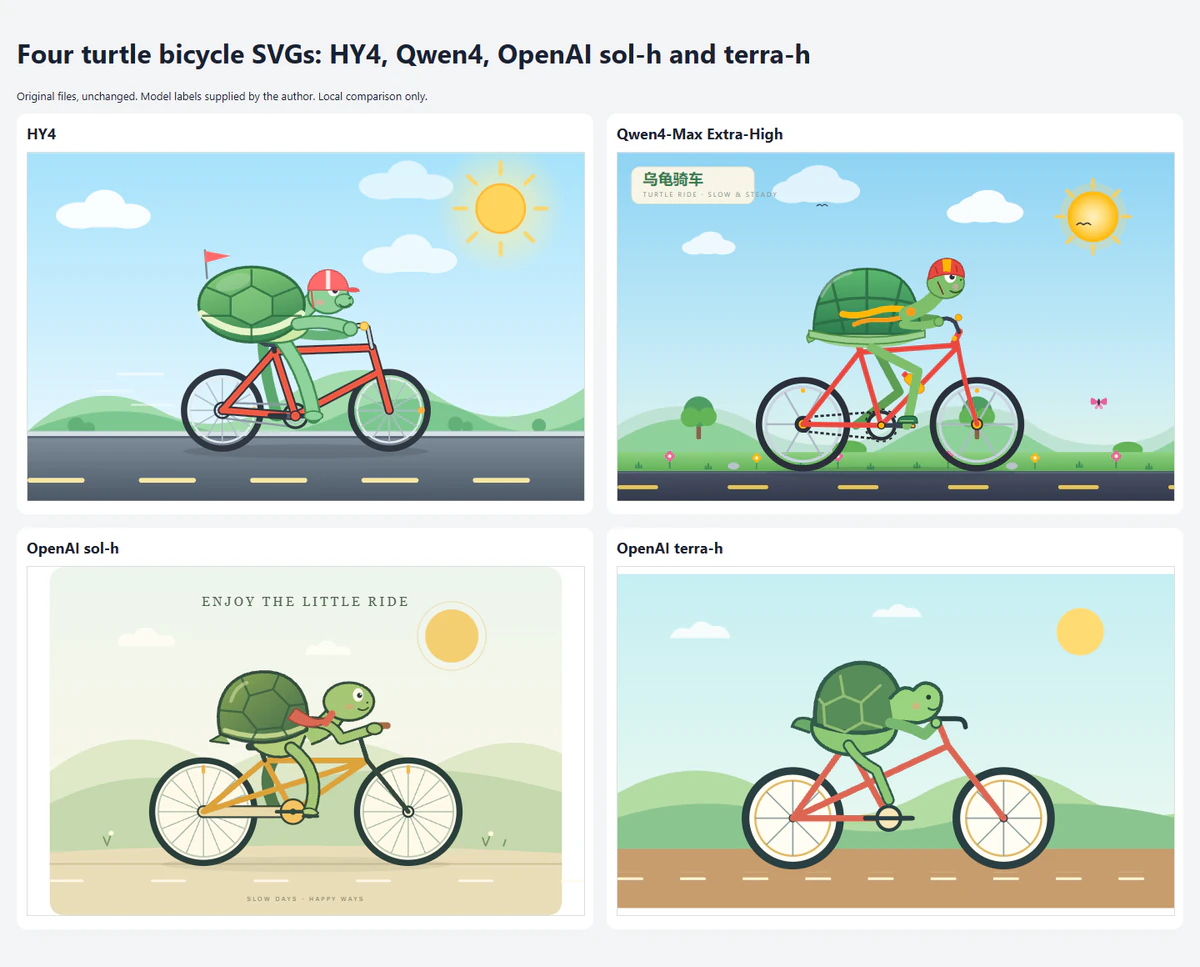
Four AI-generated turtle bicycle SVGs, ranked by visual design and motion. Qwen4 adds the most scenery, but a crank error changes the result.
Like it ? share it
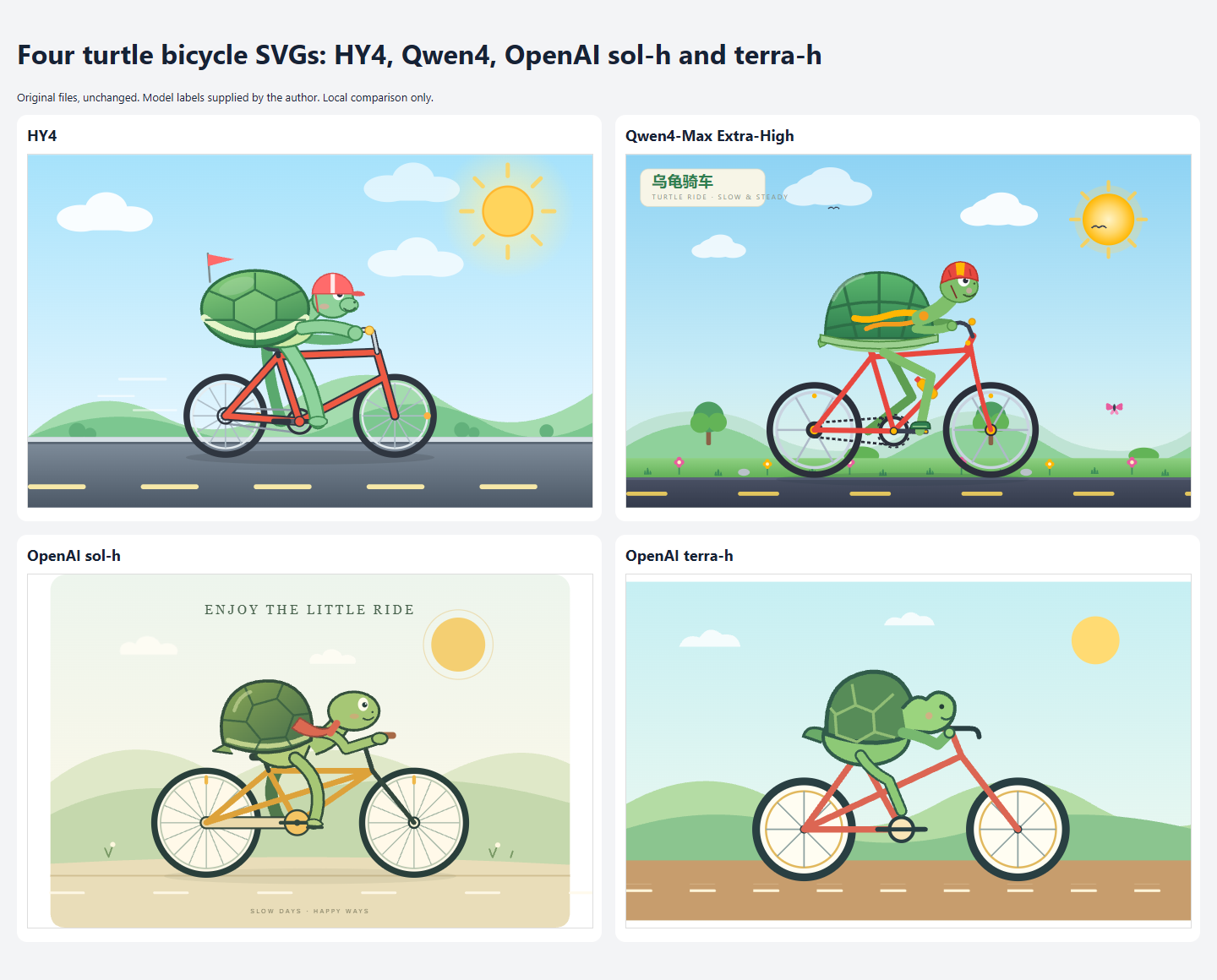
My overall order for these four files is OpenAI sol-h, HY4, OpenAI terra-h, then Qwen4-Max Extra-High.
Qwen4 made the scene with the most detail. OpenAI sol-h made the scene I would choose first. The difference becomes clear when the bicycle moves.
For this review, the main requirement is a turtle that appears to pedal a bicycle. I give correct motion more importance than extra scenery. Color, composition, character, and the amount of repair needed also affect my order.
What I compared
I inspected four supplied SVG files without changing their artwork or animation code. I opened them in the same Chromium browser and compared still images with timed animation samples.
The names identify the supplied runs. The Qwen file was identified as Qwen4-Max Extra-High. The two OpenAI files carry the labels sol-h and terra-h. I retain those labels because the files do not establish full public model identifiers.
This is a comparison of four outputs, with one file per label. I did not rerun the models. The exact prompts, token budgets, generation times, and retry histories were not available for this review.
The order below is my judgment of these files. It is not a general model ranking or a controlled comparison of reasoning settings.
| Overall place | Supplied label | My main reason | Main limitation |
|---|---|---|---|
| 1 | OpenAI sol-h | The most coherent design, with a stable bicycle mechanism | Small differences between the leg and pedal paths |
| 2 | HY4 | A clear character and a crank that stays on the bicycle | Fast motion and a less exact foot path |
| 3 | OpenAI terra-h | A simple, readable scene with the crank attached | The ankle stays in one position relative to the bicycle |
| 4 | Qwen4-Max Extra-High | The richest setting and the most secondary motion | Crank and shoe groups turn about the wrong origin |
First: OpenAI sol-h feels like one complete design
This is the file I enjoy looking at most. The cream background, muted greens, gold frame, and coral scarf work together. The turtle has a friendly face, and the scene has space around the subject.
The short captions also fit the calm mood. I get a clear impression of a small illustrated card, rather than a collection of separate details.
Its mechanism supports that impression. The crank turns about (475, 478), at the bicycle's crank center. The near shoe follows a circular motion path. The legs use eight intervals around the same two-second cycle.
It is not mechanically exact. At the sampled intermediate phases, the near leg endpoint and crank endpoint differed by up to about 2.45 SVG user units. These are drawing coordinates, not screen pixels or an accuracy score.
That small difference leaves room for refinement. It does not cause the mechanism to leave the bicycle. For the balance of style and motion, this is my first choice.
Second: HY4 gives me the clearest energetic cartoon
HY4 feels more energetic. The red helmet, small flag, large shell, and bold bicycle frame make the subject easy to recognize. The turtle looks ready for a cheerful trip.
Its color choices are more direct than sol-h's. The sky is bright blue, the road is gray, and the bicycle is coral red. I find the result clear and appealing, although less restrained.
HY4 also gets an important structural detail right. Its crank turns about (385, 378). The bicycle moves slightly up and down as a group, and the crank center stays attached to it.
The foot motion has a smaller problem. Each foot follows four straight intervals around the crank, while the crank endpoint follows a circle. Between the main positions, the two paths differ.
The largest difference in the sampled near-foot positions was about 7.62 SVG user units. The broad leg and foot shapes partly hide it. The 1.1-second cycle also makes the motion feel busy.
I place HY4 second because the main action remains readable. Its weaker point is refinement, rather than a lost connection between the bicycle and its crank.
Third: OpenAI terra-h is clear, but the leg does not complete the action
Terra-h has the simplest presentation. I like the broad shapes, limited colors, and clear silhouette. The turtle is immediately recognizable, even without a helmet, scarf, or caption.
However, the leg movement does not convince me. The crank turns, but the animated leg endpoint stays 26 units above the crank center. The knee changes shape while the ankle stays in the same relative position.
At one quarter of the 1.2-second cycle, the near crank endpoint is below the center. The leg endpoint is still above it. The measured separation is 52 SVG user units.
The dark outer leg path is also static while the lighter inner path changes. This makes the leg look less like a connected moving limb.
I place terra-h above Qwen4 because its bicycle mechanism stays in the scene. It still needs a real foot-to-pedal path before I would call the riding motion convincing.
Fourth: Qwen4-Max Extra-High impresses me first, then loses the mechanism
Qwen4 gives me the strongest first impression of effort and activity. It adds trees, flowers, birds, dust, a butterfly, a scarf, and a blinking eye. Several background layers move at different speeds.
I especially like the idea of a small world around the rider. The moving chain and separate wheel and pedal periods show more ambition than the simpler files.
The source sets the wheel cycle to 1.26 seconds and the crank cycle to 2.52 seconds. This gives two wheel turns per crank turn. The problem is where the crank turns.
The near crank uses this animation:
<animateTransform attributeName="transform"
  type="rotate" values="0;360"
  dur="2.52s" repeatCount="indefinite"/>
The group contains coordinates around (455, 470), but the animation supplies no center. Its parent group does not move the origin to that point.
Under the SVG transform rules, a rotation without center coordinates uses the current coordinate origin. Here, that is (0, 0).
At one quarter of the cycle, or 0.63 seconds, the near crank center moves to approximately (-470, 455). The bicycle's intended center remains (455, 470). The crank has moved outside the visible drawing.
The far crank and the outer shoe groups have the same missing-center structure. This is more than a small difference between a foot and a pedal. The moving mechanism leaves the bicycle while the legs continue their separate paths.
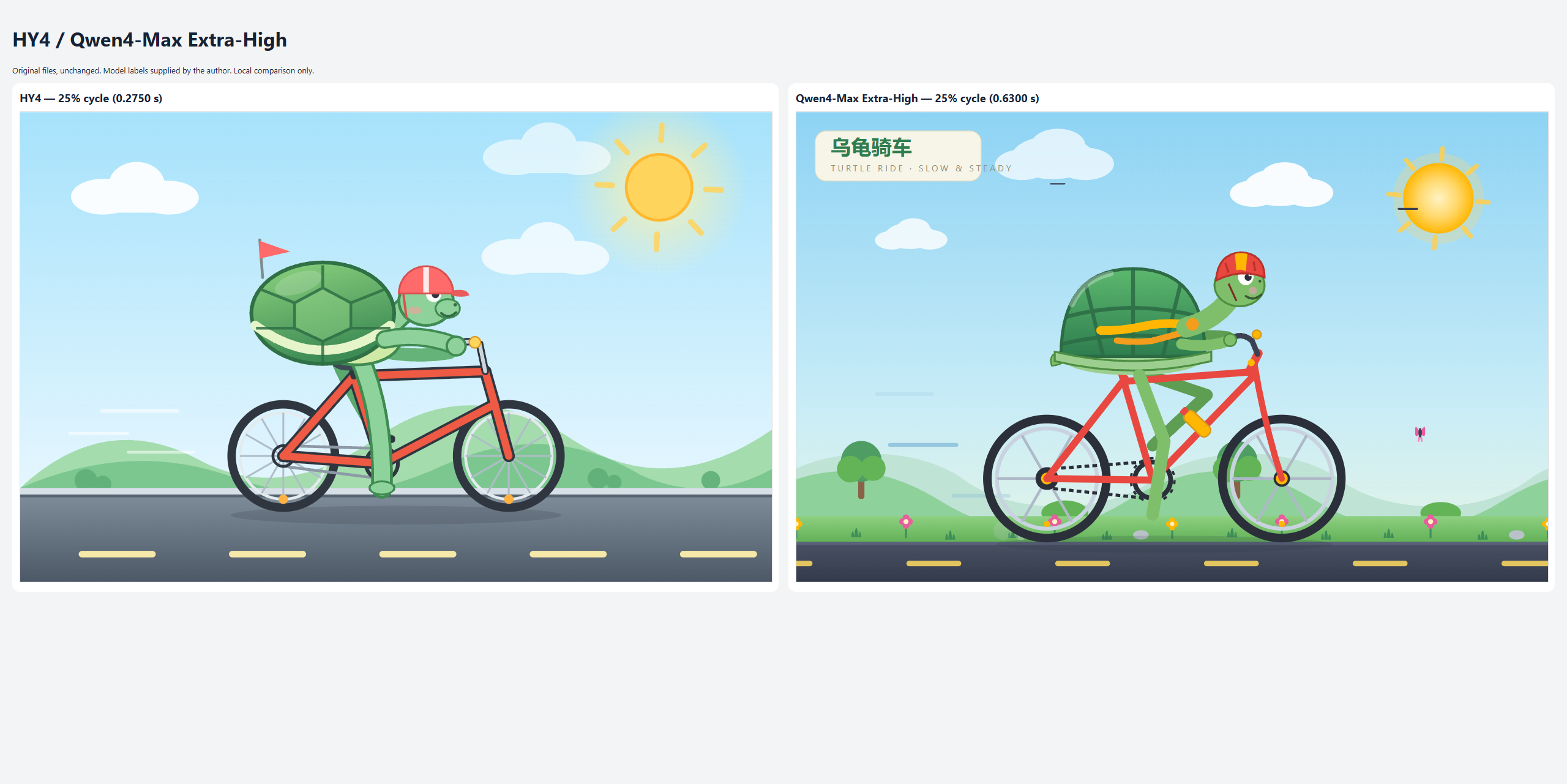
That changes my reaction to the image. The scenery still looks attractive, but I stop believing that the turtle is driving the bicycle. For a riding animation, this is the most serious defect in the four files.
A targeted repair would give each outer crank and shoe group the correct center. For the near crank, the values would become:
values="0 455 470;360 455 470"The far groups also need their half-cycle offset. The inner counter-rotation must stay in the pedal's local coordinates. This is a proposed repair, not a corrected Qwen output used in this ranking.
More animation code did not give the best result
| File label | File size, bytes | SVG viewBox | Animation elements in source |
|---|---|---|---|
| OpenAI sol-h | 8,307 | 1000 × 680 | 11 |
| HY4 | 14,768 | 800 × 500 | 25 |
| OpenAI terra-h | 4,329 | 800 × 480 | 6 |
| Qwen4-Max Extra-High | 21,457 | 960 × 600 | 49 |
The animation count includes <animate>, <animateTransform>, and <animateMotion> elements in the source. Reused definitions can create more than one visible instance. The count is not a frame-rate or rendering-cost measurement.
All four files parsed as XML and displayed in the browser. Their animation timelines advanced. The inspection found no scripts or external asset references in the supplied SVGs.
Those checks establish that the files run. They do not establish that the parts move together correctly.
The SVG animation specification also explains why matching endpoints need attention. Linear interpolation joins listed values. Four or eight sampled foot positions do not automatically produce an exact circular path.
My final choice
For overall visual appeal alone, my order would be sol-h, Qwen4, HY4, then terra-h. I prefer sol-h's quieter palette, while Qwen4 offers the most scene detail. These are matters of taste.
For the complete animated result, I keep sol-h first, HY4 second, terra-h third, and Qwen4 fourth. I give more importance to the rider, foot, pedal, and bicycle remaining connected.
The useful lesson from these four files is simple: inspect the relationships between moving parts. A scene can look finished before its mechanism works.
Before accepting an AI-generated SVG animation, I would inspect the first frame, intermediate phases, and the end of the cycle. Then I would check the pivot coordinates, shared timing, and contacts between parts.
This review covers one Chromium browser and selected timeline samples. It does not measure mobile performance, cross-browser behavior, accessibility under reduced-motion preferences, generation cost, or a model's repeatability.